
SOPHI professional research reference
Tennessee structural pests: evidence and professional scope.
An evidence-led Tennessee reference for recognizing wood-destroying organisms, interpreting regional conditions, documenting visible findings, and locating authoritative university, state, and technical guidance.
Prepared by the School of Professional Home Inspection · Tennessee reference edition · Primary-source links included
REFERENCE LENS
The organism matters, but the building story matters too: moisture, access, material, location, extent, and the limits of a visual inspection.
Executive summary
Evidence first. Identification second.
A home inspector rarely finds a perfectly labeled insect. More often, the first clue is a mud tube, a pile of debris, an exit hole, softened wood, staining, or a moisture pathway. This reference helps organize those observations without turning a visual home inspection into a regulated pest inspection.
This publication synthesizes primary guidance from the University of Tennessee, the Tennessee Department of Agriculture, Tennessee home-inspector authorities, the USDA Forest Products Laboratory, and the National Weather Service. The linked primary sources remain the controlling references for regulatory requirements and technical detail.
Statewide priorities
Native subterranean termites and moisture-related wood decay lead the list, followed by carpenter ants, beetles, and carpenter bees.
Regional watch
West Tennessee, especially Shelby County, requires added awareness of Formosan subterranean termites and post-flood moisture.
Scope discipline
Describe visible building conditions, disclose limitations, and refer identification, activity, treatment, or clearance questions to qualified professionals.
01 · Termite profile
Subterranean termites are the statewide concern
The primary Tennessee termite species identified by University of Tennessee Extension are the eastern subterranean termite, Reticulitermes flavipes; the southeastern subterranean termite, R. virginicus; and the light southeastern subterranean termite, R. hageni. Native subterranean termites require moisture and normally maintain a connection with soil.
UT Extension: Subterranean Termite Control, PB 1344North American Termite Survey
Seasonal clues
- R. flavipes commonly swarms from March through May.
- R. virginicus commonly swarms from April through June and may also swarm in fall.
- R. hageni commonly swarms from August through October.
- Heated structures can alter normal swarm timing.
Evidence and inspection locations
- Earthen shelter tubes on foundations, piers, masonry, wood, cracks, or utility penetrations.
- Creamy-white workers or soldiers in tubes or damaged wood.
- Indoor swarmers or piles of equal-sized shed wings, often near windows.
- Soft, channeled, hollow, or unsound wood with soil-like material in galleries.
- Foundation perimeters, crawlspaces, basements, slab edges, sill plates, rim joists, joist ends, posts, porches, steps, garages, decks, additions, and concealed foundation edges.
Reporting caution: Record the visible evidence and access limitations. Do not declare a structure termite-free, and do not declare an old-looking tube inactive without adequate evidence.
Formosan subterranean termites
Formosan subterranean termites, Coptotermes formosanus, deserve special vigilance in West Tennessee. Repeated detections support an elevated watch in Shelby County. Earlier Tennessee detections occurred in Henderson County, and a transported-boat case was identified in Roane County near Watts Bar Lake. These records do not establish uniform statewide distribution.
Possible clues include larger yellow-brown alates with densely hairy wings, evening swarms, oval or teardrop-shaped soldier heads, unusually broad hollowing, and above-ground carton nests where building moisture is sufficient. Suspected Formosan or other Coptotermes findings require qualified evaluation and state reporting.
UT Formosan Subterranean Termite Survey Update
Drywood and dampwood termites
Drywood termites do not naturally occur in Tennessee, but they can arrive in furniture, antiques, salvaged lumber, and other transported wood. Hard, concave, six-sided pellets near kick-out holes are a useful comparison clue; professional identification is still appropriate. Dampwood termites should not receive routine Tennessee emphasis because authoritative state sources reviewed for this guide do not establish them as a regular structural pest.
02 · Carpenter ants
Excavated wood, coarse debris, and a moisture story
UT Extension reports approximately ten carpenter-ant species in Tennessee. Structure-associated colonies are often large and blackish, although reddish-orange and mixed-color forms also occur. Carpenter ants excavate galleries rather than digesting wood. They can use dry wood, insulation, false ceilings, hollow columns, and voids, but moisture-damaged wood is especially important.
Look for
Coarse sawdust, wood splinters, insect fragments, dead ants, smooth galleries, repeated worker activity, indoor swarmers, and damp or hollow wood.
Check around
Sinks, tubs, windows, doors, roof and gutter leaks, downspouts, porch columns, decks, wall voids, crawlspaces, basements, woodpiles, stumps, and landscape timbers.
Carpenter-ant galleries are usually clean and smooth; termite galleries commonly contain soil or mud-like material. Large field ants can resemble carpenter ants, so a few foragers alone do not establish a structural nest.
UT Extension: Carpenter Ants, PB 1599UT Urban Integrated Pest Management
03 · Wood-boring beetles
Hole shape, frass, wood type, and freshness all matter
Lyctid powderpost beetles
Fine flour-like frass and small round holes in seasoned hardwood such as oak, ash, and hickory used in flooring, trim, paneling, frames, plywood, and furniture.
Anobiid beetles
Grittier frass and small holes in hardwood or softwood. Damp, poorly ventilated crawlspaces and basements increase concern for framing.
Old house borer
Oval emergence holes around one-quarter inch and packed galleries in seasoned softwood, especially pine construction lumber.
Active versus old
Fresh light-colored frass, new holes after cleaning, live specimens, and recurring seasonal evidence support activity. Weathered holes and caked frass may be old but are not conclusive alone.
Document hole size and shape, frass texture, affected material, moisture, distribution, visible section loss, and specimens. Tennessee’s 18-percent moisture rule applies to certain preventive beetle pesticide treatments; it is not a universal home-inspection diagnosis.
UT Extension: Managing Pests Around the Home, PB 1303Tennessee Pest-Control Rules
04 · Carpenter bees
Round entrance holes in exposed wood
The eastern carpenter bee, Xylocopa virginica, commonly excavates an entrance hole near three-eighths inch in diameter, turns at a right angle, and follows the wood grain. Repeated reuse and enlargement can create long galleries over several seasons.
- Fascia, soffits, siding, porch ceilings, railings, posts, decks, fences, and trim.
- Nearly round openings, coarse sawdust, yellow-brown staining, repeated bee activity, and woodpecker damage.
- Warmer sunny exposures and unfinished or weathered softwood.
Separate the localized wood damage from the stinging-insect concern. Recommend qualified pest evaluation where activity is extensive, access is hazardous, or pesticide use is contemplated.
05 · Moisture and fungal decay
Follow the water as carefully as the damaged wood
Moisture-related deterioration is a statewide structural concern and can also favor carpenter ants, anobiid beetles, and termite activity. Common locations include crawlspace sills, joists, beams, posts, subflooring, deck and porch connections, rim joists, roof sheathing, openings, siding, trim, plumbing penetrations, bathrooms, kitchens, condensate areas, and basement framing.
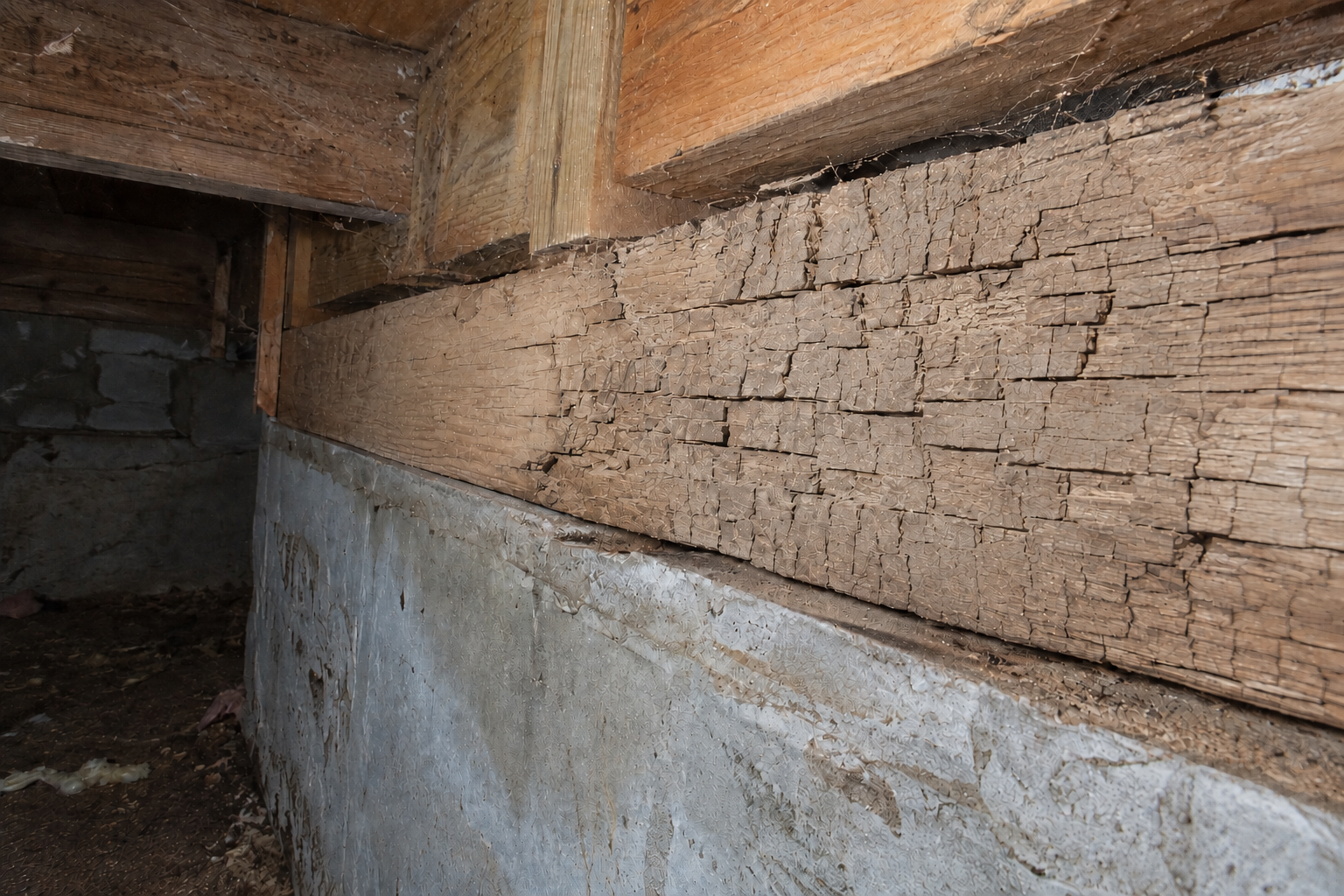
- Softness, crushing, probing failure, stringy or cubical texture, and lost wood section.
- Depressed surfaces, failed fasteners, fungal fruiting bodies, sagging, and staining.
- Surface mold or discoloration alone does not prove structural decay.
Wood-moisture context: USDA wood science uses moisture below 20 percent as a practical safety margin against decay. Serious decay generally requires moisture near or above fiber saturation, commonly around 30 percent. A meter reading remains a screening datum, not a fungus identification or concealed-damage measurement.
06 · Tennessee regional conditions
Climate and terrain change the inspection story
Tennessee’s warm, humid growing season and year-round precipitation support long termite activity periods and repeated wetting. Nashville’s 1991-2020 normal annual precipitation is about 50.5 inches, but topography produces significant regional differences.
West Tennessee
Warm conditions, river systems, low-lying terrain, flooding, crawlspace and sill moisture, and the state’s strongest Formosan-termite vigilance in Shelby County.
Middle Tennessee
Foundation moisture, drainage, decks, porches, wooded and sloped sites, and rainfall that increases toward parts of the Highland Rim and Cumberland Plateau.
East Tennessee
Mountain rainfall variability, steep-site drainage, wooded lots, elevated decks, crawlspaces, basements, and slower drying in shaded exposures.
Middle Tennessee climatology ranges from less than 48 inches near Nashville to more than 57 inches in the southwest and over 62 inches on the southern Cumberland Plateau near Monteagle. Approximately two-thirds of precipitation commonly falls from November through May.
NWS Nashville Climate RecordsNWS Middle Tennessee Heavy-Precipitation Climatology
07 · Construction hotspots
Where access, water, and cellulose meet
Crawlspaces
Review soil moisture, drainage, vapor-retarder condition, standing water, plumbing or duct condensation, wood debris, low clearance, blocked access, concealed framing, insulation, and wood-to-soil contact.
Basements and slabs
Inspect sill plates, joist ends, partitions, stairs, utility penetrations, leakage, condensation, finished walls, slab edges, expansion joints, garages, porches, steps, and additions. Finished surfaces can conceal both moisture and termite entry.
Exterior cladding, decks, porches, and logs
Below-grade foam, EIFS, stucco, siding, and decorative veneers can conceal foundation edges or hold moisture. At exposed wood, inspect ledgers, posts, beam ends, stringers, rail attachments, end grain, checks, sealant failures, and repeated wetting.
Common conducive conditions: buried cellulose; mulch, vegetation, landscape timbers, firewood, or lumber against the building; negative grading; short downspouts; irrigation wetting; ponding or flooding; roof, opening, plumbing, appliance, or condensate leaks; wet crawlspace soil; concealed foundation edges; exposed unpainted wood; and imported or salvaged wood.
08 · Field identification
A comparison table for visible clues
| Possible concern | Visible clues | Important caution |
|---|---|---|
| Native subterranean termite | Mud tubes, soil in galleries, creamy workers, rectangular-headed soldiers, equal-sized wings, and concealed soil pathways. | Do not infer inactivity from appearance alone. |
| Formosan subterranean termite | Larger yellow-brown alates, dense wing hairs, evening swarms, oval-headed soldiers, broad hollowing, or possible aerial nests. | Regional and introduced-pest concern; obtain qualified confirmation. |
| Drywood termite | Hard six-sided pellets, kick-out holes, localized dry-wood galleries, and no mud connection. | Not native or routine in Tennessee; imported wood is the main context. |
| Carpenter ant | Large ants, coarse mixed debris, clean smooth galleries, and frequent moisture association. | Foragers do not prove a structural nest. |
| Lyctid beetle | Very fine powder and small round holes in seasoned hardwood. | Freshness and material type matter. |
| Anobiid beetle | Grittier frass and small holes in hardwood or softwood, often damp framing. | Moisture and ventilation are part of the evaluation. |
| Old house borer | Oval holes near one-quarter inch and packed galleries in seasoned softwood. | Document extent and visible structural loss. |
| Carpenter bee | Round entrance hole near three-eighths inch, sawdust, staining, and repeated exterior use. | Separate wood damage from the stinging-insect issue. |
| Fungal decay | Softness, stringy or cubical texture, lost section, and moisture. | Staining alone does not establish structural decay. |
09 · Reporting and referral
Keep the observation separate from the pest conclusion
Tennessee home-inspector standards require the inspection report to state that the inspection does not address wood-destroying insects and organisms. The standards also say the home inspector is not required to report the presence or absence of pests such as wood-damaging organisms, rodents, or insects.
A practical home-inspection narrative can still describe visible building conditions within the inspector’s license, agreement, and insurance: damaged framing, moisture, holes, tubes, debris, wings, access limitations, and other observations. Avoid unconfirmed species, activity, treatment, or clearance conclusions.
- Identify the component, material, and exact location.
- Describe the visible pattern and extent.
- Record accessible contributing conditions and important limitations.
- Recommend a qualified pest professional for organism identification, current activity, regulated inspection, treatment, or clearance.
- Recommend structural evaluation when section loss, sagging, failed connections, damaged posts or beams, or concealed extent may affect capacity.
Referral triggers: visible live insects, fresh frass, swarmers, mud tubes, pellet piles, extensive or concealed damage, suspected Formosan termites, uncertain identification, transaction-sensitive evidence, or any request for treatment or clearance.
Tennessee Home Inspector Rules and LawsOfficial Standards of Practice, Chapter 0780-05-12
10 · Tennessee regulation
Home inspection and regulated WDI work are separate services
Home inspectors are regulated by the Tennessee Department of Commerce and Insurance. Wood-destroying-organism pest control is regulated by the Tennessee Department of Agriculture. The WDO category covers termites, wood borers, carpenter bees, carpenter ants, and decay, and applicants must also hold Category 7 certification.
A company offering custom pesticide application needs a pest-control charter for each location and an appropriately licensed individual for each category offered. Regulated transaction reports use prescribed NPMA or HUD forms, may be issued only through properly chartered and qualified operations, and carry a 90-day warranty under Tennessee law.
Tennessee rules require Formosan or other Coptotermes infestations to be treated with an appropriately labeled pesticide and reported to the Department of Agriculture. This educational reference supports recognition and referral; it does not authorize treatment advice, pest-control contracting, termite clearance, regulated WDI reports, or credential-dependent conclusions.
TDA Certification, Licensing and ChartersTennessee Pesticide ChartersTennessee Pest-Control FormsTennessee Pest-Control Rules
Official source library
Tennessee, university, and technical resources
Use these primary resources for deeper identification, current agency requirements, local Extension help, climate context, and wood science.
University of Tennessee and local Extension
UT Department of Entomology and Plant PathologyDepartment programs, faculty, research, and Tennessee pest education.
UT Entomology Extension and OutreachSoil, Plant and Pest Center and insect-identification services.
UT Urban Integrated Pest ManagementUrban and structural pest guidance for Tennessee.
UT Extension County OfficesLocal Extension assistance in all 95 Tennessee counties.
Subterranean Termite Control, PB 1344Tennessee termite biology, seasonal activity, evidence, prevention, and management context.
Carpenter Ants, PB 1599Tennessee species, nesting, evidence, identification, and moisture associations.
Carpenter Bees, W 876Entrance holes, galleries, affected wood, behavior, and management background.
Managing Pests Around the Home, PB 1303Wood-boring beetles and other residential pest evidence.
Drywood Termites in TennesseeImported-wood pathways, pellets, documented Tennessee cases, and identification context.
Formosan Subterranean Termite Survey UpdateTennessee surveillance and distribution research.
State rules, licensing, and regulated reports
TDA Certification, Licensing and ChartersCommercial certification, licensing categories, and charter information.
Tennessee Pesticide ChartersBusiness requirements for pesticide services.
Tennessee Pest-Control FormsOfficial applications and regulated pest-control forms.
Tennessee Pest-Control Rules and RegulationsOfficial structural pest-control requirements and treatment rules.
Tennessee Home Inspector Rules and LawsCurrent state home-inspector statutes and administrative rules.
Home Inspector Standards of PracticeChapter 0780-05-12, including the wood-destroying-organism scope statement.
Termite mapping, climate, and wood science
North American Termite SurveySpecies records and regional termite-distribution context.
USDA Forest Products Laboratory Wood HandbookWood moisture, biodeterioration, material behavior, and decay science.
National Weather Service Nashville Climate RecordsNashville temperature and precipitation normals.
Middle Tennessee Heavy-Precipitation ClimatologyTopographic rainfall differences and seasonal precipitation patterns.